
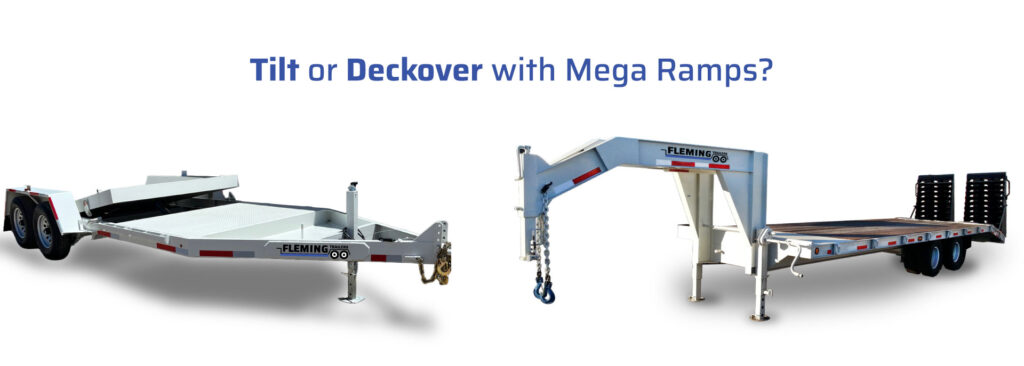
When it comes to hauling heavy equipment, there’s no one-size-fits-all trailer. The right trailer design can save hours of work, prevent injuries, and protect your investment for years to come. Two of the most popular options among professional haulers, contractors, and farmers are tilt trailers and deckover trailers with mega ramps.
At Fleming Trailers, we’ve spent decades helping Arizona haulers find the perfect trailer for their equipment and operation. Whether you’re transporting skid steers, compact tractors, or utility machinery, understanding the difference between these trailer types — and when to use each — is key to getting the most value and performance on the road.
The Basics: Tilt vs. Deckover Trailers

Before diving into features, let’s start with what sets these trailers apart.
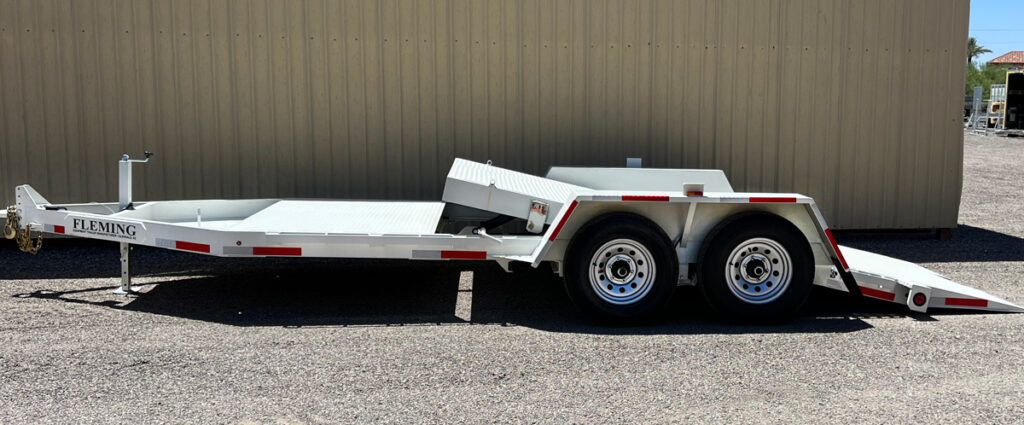
- Tilt Trailers: The bed pivots back on its hinge, lowering the loading end to the ground for easy drive-on loading. No ramps required.
- Deckover Trailers with Beavertail or Mega Ramps: The deck sits over the wheels, offering a full-width surface with a sloped tail and fold-down ramps (like our MightiRamp) for loading large or wide equipment.
Both designs are heavy-duty, but they serve different hauling styles and needs.
When to Choose a Tilt Trailer
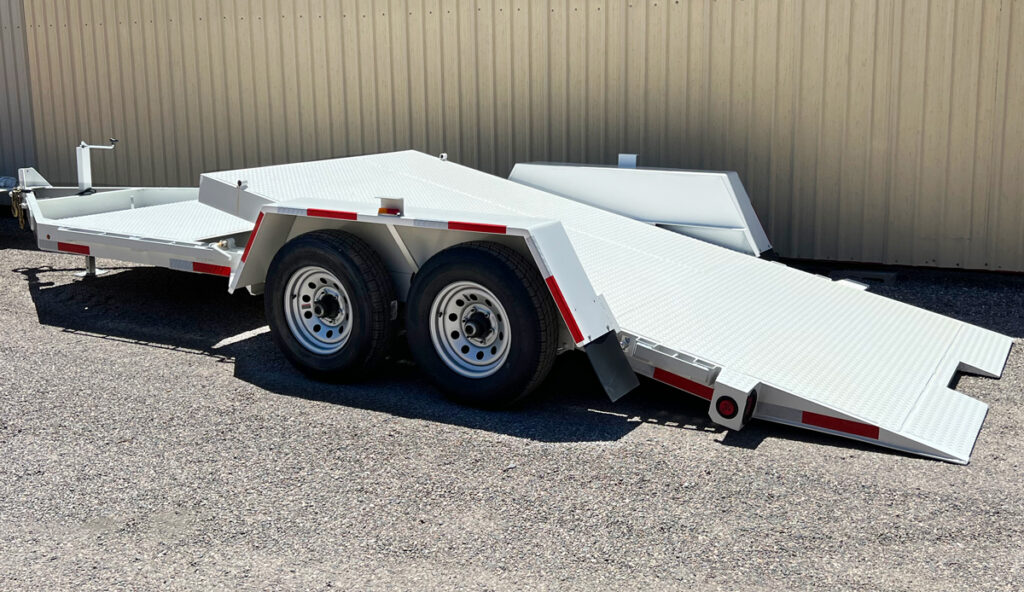
If speed, safety, and simplicity are top priorities, a tilt trailer may be your best bet. These are especially popular among landscapers, municipalities, and equipment rental companies who load and unload multiple times per day.
1. Effortless Loading for Low-Clearance Machines
Tilt trailers excel at handling compact, low-profile equipment such as:
- Skid steers
- Scissor lifts
- Mini excavators
- Zero-turn mowers
- Compact tractors
Because the bed lowers directly to the ground, there’s no steep approach angle and no need for separate ramps. That makes it easier (and safer) to drive equipment on and off, even on job sites with uneven terrain.
2. Faster, Smoother Operation
Forget handling heavy steel ramps. A hydraulic or gravity tilt system cuts setup time dramatically. Operators simply pull a lever or release a latch, and the bed tilts automatically — saving minutes per load and reducing operator strain.
That’s time you get back on every job site.
3. Lower Deck Height = Better Stability
Tilt trailers, assuming the deck rides between the wheels, ride lower to the ground, which means a lower center of gravity and improved towing stability. When hauling compact but dense machinery like skid steers or mini loaders, that extra stability matters — especially at highway speeds or on Arizona’s winding rural roads.
4. Low Maintenance, High ROI
With fewer moving parts and no removable ramps, tilt trailers are easy to maintain. Routine checks for hinges, hydraulic fluid, and deck condition keep them running strong for years.
For frequent use and compact loads, the tilt trailer offers unmatched efficiency.
When to Choose a Deckover Trailer with Mega Ramps
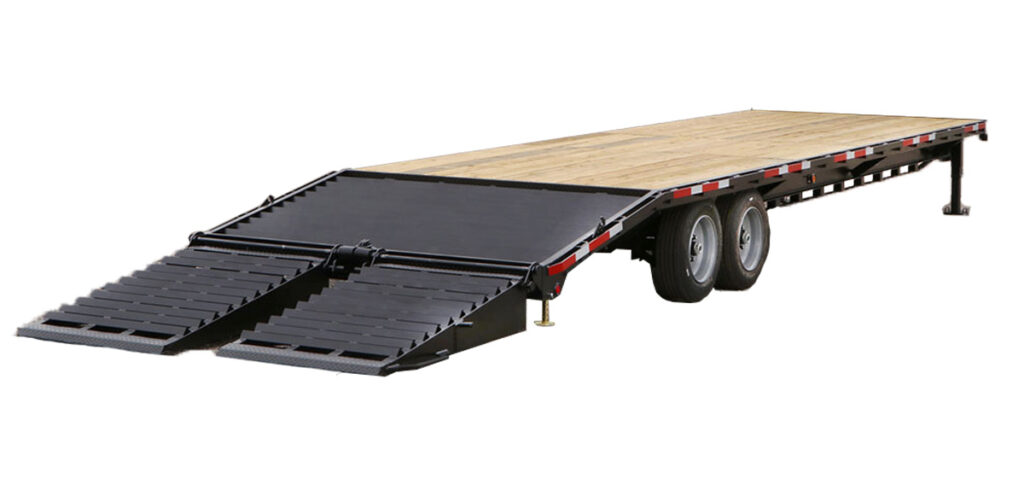
If you’re hauling bigger, wider, or multiple pieces of equipment, a deckover trailer with mega ramps is the tool for the job.
The deckover design places the trailer bed above the wheels, creating a full-width, flat platform — perfect for large or irregularly shaped equipment that wouldn’t fit between fenders on a standard equipment trailer.
1. Maximum Deck Space and Flexibility
Deckovers give you more usable space for hauling:
- Backhoes and dozers
- Large tractors
- Pallets of building materials
- Attachments or multiple compact machines
The extra width (typically 96 inches or more) means you can load from edge to edge, without worrying about wheel wells or fender clearance.
2. Built for Heavy Loads and Rugged Terrain
Deckover trailers also shine when it comes to durability. Their higher deck provides better ground clearance, which makes them ideal for uneven job sites, fields, and construction zones.
For example, a tandem axle deckover can handle the weight of a backhoe, while keeping enough suspension strength for long-distance hauling.
3. Smooth Loading with Mega Ramps
This is where the MightiRamp by Fleming Trailers comes in.
Traditional fold-down ramps can be narrow, uneven, and difficult to deploy. The MightiRamp eliminates those issues with a full-width, 11-foot-long platform that creates a seamless transition from ground to deck.
- Unmatched Strength: 1,200 lbs of solid American steel
- Full-Width Confidence: Up to 102 inches wide for total stability
- Longer, Smoother Loading: Low approach angle perfect for skid steers or tractors
- One-Person Operation: Despite its strength, it’s engineered for easy deployment and storage
For professionals hauling heavy equipment daily, the MightiRamp isn’t just a convenience — it’s a safety and productivity upgrade.
When to Choose a Tilt Trailer
If speed, safety, and simplicity are top priorities, a tilt trailer may be your best bet. These are especially popular among landscapers, municipalities, and equipment rental companies who load and unload multiple times per day.
1. Effortless Loading for Low-Clearance Machines
Tilt trailers excel at handling compact, low-profile equipment such as:
- Skid steers
- Scissor lifts
- Mini excavators
- Zero-turn mowers
- Compact tractors
Because the bed lowers directly to the ground, there’s no steep approach angle and no need for separate ramps. That makes it easier (and safer) to drive equipment on and off, even on job sites with uneven terrain.
2. Faster, Smoother Operation
Forget handling heavy steel ramps. A hydraulic or gravity tilt system cuts setup time dramatically. Operators simply pull a lever or release a latch, and the bed tilts automatically — saving minutes per load and reducing operator strain.
That’s time you get back on every job site.
3. Lower Deck Height = Better Stability
Tilt trailers, assuming the deck rides between the wheels, ride lower to the ground, which means a lower center of gravity and improved towing stability. When hauling compact but dense machinery like skid steers or mini loaders, that extra stability matters — especially at highway speeds or on Arizona’s winding rural roads.
4. Low Maintenance, High ROI
With fewer moving parts and no removable ramps, tilt trailers are easy to maintain. Routine checks for hinges, hydraulic fluid, and deck condition keep them running strong for years.
For frequent use and compact loads, the tilt trailer offers unmatched efficiency.
Side-by-Side Comparison: Tilt vs. Deckover with Mega Ramps
| Feature | Tilt Trailer | Deckover with Mega Ramps |
|---|---|---|
| Loading Method | Tilting bed, no ramps | Beavertail + full-width ramps |
| Best For | Compact, low-clearance equipment | Wide, heavy, or multiple machines |
| Deck Height | Lower (between fenders) | Higher (over wheels) |
| Approach Angle | Very low | Slightly higher |
| Deck Width | Narrower (limited by fenders) | Full width (96–102”) |
| Setup Time | Quick (no ramp handling) | Slightly longer (deploy ramps) |
| Ground Clearance | Moderate | Higher, great for off-road |
| Maintenance | Minimal | More moving parts |
| Versatility | Compact equipment | Heavy machinery, materials, attachments |
| Optional Features | Gravity/power tilt, hydraulic assist | MightiRamp, hydraulic ramps, gooseneck configuration |
Cost Comparison: Tilt Trailer vs Deckover with Mega Ramps
| Category | Tilt Trailer | Deckover Trailer with Mega Ramps |
|---|---|---|
| Typical Sale Price | Starts around $8,000–$12,000 for standard tilt models | Typically $12,000–$18,000 for deckover with mega ramp options |
| Upfit / Ramp Feature | Standard tilt – no fold-down ramp system | Includes Mega Ramp upgrade or optional hydraulic ramp system |
| Maintenance Cost Over 5 Years | Low-maintenance pivot & hinge system; occasional hydraulics / hinge checks | Ramp hinge maintenance, ramp locking pins, hinge lubrication, periodic structural inspection |
| Resale Value | Decent resale if well-maintained; tilt mechanism remains valuable | Higher residual—but depends on condition of ramps and deck surface |
| Load Versatility ROI | Ideal for compact equipment: faster loading every time | Versatile options for oversized or tracked machines; may generate more utility over broad jobs |
| Use Case Value | Frequent, repeated use (e.g. landscapers loading mowers daily) | Heavy-duty use (large machinery, mixed loads, construction tasks) |
| Ground Clearance | Moderate | Higher, great for off-road |
| Maintenance | Minimal | More moving parts |
| Versatility | Compact equipment | Heavy machinery, materials, attachments |
| Optional Features | Gravity/power tilt, hydraulic assist | MightiRamp, hydraulic ramps, gooseneck configuration |
Key Considerations When Choosing Your Equipment Trailer

Before deciding between a tilt and a deckover, consider these factors:
- Equipment Type — Wheeled or tracked machines require different loading angles. A tilt trailer is perfect for low-clearance equipment like scissor lifts, while a deckover handles larger tracked units.
- Frequency of Use — If you load multiple times daily, the tilt’s simplicity saves time. For heavier, occasional hauls, deckovers with mega ramps offer flexibility.
- Tow Vehicle — Check your truck’s towing capacity and hitch setup. Gooseneck trailers provide better weight distribution for heavy-duty hauling.
- Terrain — Smooth shop floors or paved areas favor tilt trailers. Rough, uneven job sites benefit from the higher clearance of deckovers.
Operator Preference — Some haulers prefer the “load and go” efficiency of a tilt bed, while others value the adaptability of a deckover.
Why Arizona Haulers Trust Fleming Trailers
Here in Arizona, equipment haulers face unique challenges — high heat, rough terrain, and long distances. That’s why Fleming Trailers builds and sells American-made, heavy-duty trailers engineered to withstand those extremes.
Our trailers feature premium construction, reinforced frames, and industry-leading components. And because we’re based locally, we understand what Arizona haulers need:
- Custom options for gooseneck, deckover, or tilt configurations
- On-site experts who help you choose the right trailer for your work
- Reliable service and maintenance to keep you moving season after season
Whether you’re a contractor, rancher, or fleet manager, we’ll help you find the perfect trailer for your equipment and workload — and make sure it’s ready to haul from day one.
FAQ: Equipment Trailer Questions
Final Thoughts
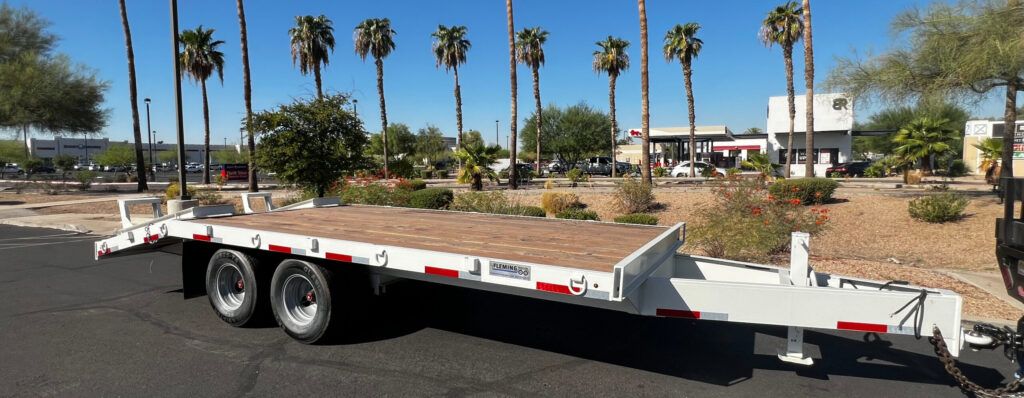
Choosing between a tilt trailer and a deckover with Mega Ramps comes down to your equipment, your work, and your workflow.
- Tilt trailers shine for speed, simplicity, and frequent hauling of compact machines.
- Deckovers with Mega Ramps offer unmatched strength, width, and versatility for heavy-duty jobs.
If you’re ready to upgrade your fleet with a trailer built to work as hard as you do, Fleming Trailers has your back — with expert advice, precision craftsmanship, and American-made durability that lasts for decades.